

Dialogue Across Difference Initiative
R
ecent national and local events have strained relationships on college campuses across the country. Like many universities and institutions, UCLA faces challenges that arise from differing perspectives on complex issues. Open and respectful dialogue is essential to a thriving campus community, and to foster the innovative, collaborative thinking that drives positive change.
The Dialogue Across Difference Initiative (DaD) wants to address these rifts by strengthening understanding and empathy among Bruins. Maia Ferdman ’15, M.A. ’15, staff director of UCLA’s Dialogue Across Difference Initiative and deputy director of the Bedari Kindness Institute, is helping to foster necessary skills for this moment in time. She says, “We are working to support our community to face the extraordinary divides of our time with resilience and skill. The challenge for us is how the University can bring people together across differences with more resilience. We’re thinking about culture change in a broad, multi-pronged way.”

DaD is an important part of Interim Chancellor Hunt’s “Four-Point Plan for a Safer, Stronger UCLA,” which uses campus resources and expertise to strengthen critical dialogue skills. In his message to the UCLA campus, Hunt said, “Part of our learning and growth comes from engagement with viewpoints we may not agree with or readily understand. While this may be uncomfortable, it is also what helps us deepen our thinking, weigh different approaches and consider new ways of looking at an issue. Ultimately, it advances truth, knowledge and understanding.”
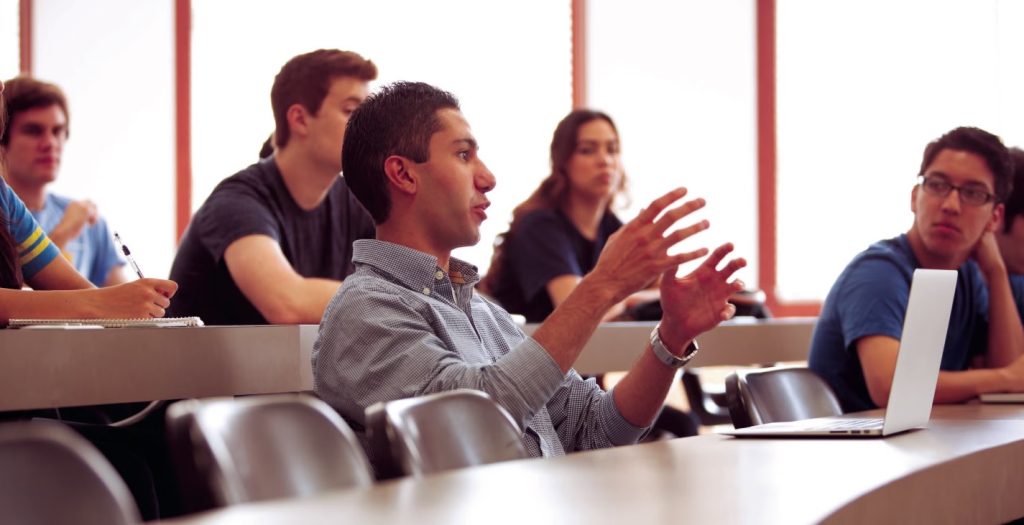
The DaD initiative is leading a campuswide culture of respectful communication through four prongs of engagement: cultivating student capacity to navigate differences; supporting faculty to support differences of opinion in the classroom; public programs, including a compassionate conversation series that models these difficult conversations across divides; and training. Together with schools and units across campus, Dialogue Across Difference will host events using a variety of frameworks to elevate many different approaches to conflict resolution. These include workshops for students, staff, faculty and alumni, training sessions, community-building exercises, internships and fellowships. These will reach campus stakeholders across disciplines and departments.
One example is a faculty fellowship that involves 16 faculty members from various disciplines, done in partnership with the Teaching and Learning Center. This fellowship aims to foster a community of practice among faculty, with the goal of reaching a significant number of students through their coursework. Additionally, campus staff with experience leading groups will receive a daylong advanced facilitation training, who will then teach others. These workshops will train people whom the campus can then call upon in moments of division to hold space for others. Possible future plans include supporting student involvement and connecting alumni with students to expand and grow skills.
The Bedari Kindness Institute is an administrative home for the Dialogue Across Difference Initiative along with the Initiative to Study Hate, a multidisciplinary research program for understanding hate. The Bedari Kindness Institute launched nearly five years ago to study and advance the practice of kindness in the world. Distinguished Professor David Myers, the Sady and Ludwig Kahn Chair in Jewish History, is the director of the Bedari Kindness Institute and of the Luskin Center for History and Policy. Ferdman says, “There’s so much connectivity between hate, kindness and dialogue. These are three sorts of distinctive efforts, each requires a different approach, but they overlap.”
DaD has also partnered with Resetting the Table, a national nonprofit co-founded by Eyal Rabinovitch Ph.D. ’05, that is “supporting collaborative deliberation in the face of strong differences,” and specializes in both the Israeli-Palestinian conflict and Republican-Democrat divides, although their training is applicable across many political differences. Through this program, UCLA is offering interactive workshops to the campus community to practice speaking about these topics using effective communication skills.
As a double Bruin with a bachelor’s in global studies and a master’s in Latin American studies, Ferdman calls her current role “a full circle moment.” She first explored the practice of engaging in effective dialogue in a Fiat Lux seminar, and later in a facilitation-training course at the Graduate School of Education & Information Science. She also traveled to the Middle East with the Olive Tree Initiative, a program that encourages the sharing of diverse ideas. She says, “Those were formative experiences that set me on my career path. Now I’m helping to find ways to support other students.”
DaD is bringing Bruins with diverse viewpoints together in meaningful discussion. These efforts aim to create lasting change by encouraging dialogue that enhances and sustains collaboration across campus. Ferdman says, “I like to say that the capacity to communicate constructively across differences is an essential leadership skill for the 21st century. We all need to be able to understand how to navigate differences because we are in a pluralistic, democratic and diverse society.”
For more information about the Dialogue Across Difference Initiative, visit their website.